
Disciples Afraid of Murray Rothbard's Ruling Elite Theory? Part II. Joe Salerno
The Omissive Case of Joseph T. Salerno


Introduction
In the initial installment of this series, we explored the writings of David Gordon and observed his tendency to downplay Rothbard’s ruling elite theory, particularly its focus on Jewish influence. In fact, Gordon went so far that he omitted the J-word even from his book Essential Rothbard. This gave Jews one minus point in our comparison between Rothbard’s Jewish and Gentile disciples.
The next disciple of Rothbard to examine is Joseph T. Salerno. It remains undisclosed whether Salerno is Jewish or of partial Jewish descent. For the time being, let us provisionally classify Salerno as Gentile.
Unlike other disciples of Rothbard, Salerno has not produced an extensive body of books. Conversely, this scarcity facilitates a more focused study of his work. Let us begin with his most significant publication, Money: Sound and Unsound, which traces the evolution of money.
Ruling elite
With numerous chapters addressing bankers, one might anticipate Salerno to reference the three prominent banking-industrial dynasties that were creating the FED and have been ruling over it ever since: WASP elite represented by the Morgans, Jewish elite represented by Rothschilds/Kuhn Loeb-Goldman Sachs group and the Rockefeller dynasty.
Regrettably, Salerno does not mention them even once. In fact, none of the chapters concentrate on the ruling elite or provide any insight into its composition. But maybe it is mentioned passingly. Let us, therefore, search for the term “ruling elite.” Result: a single instance appears:
Nonetheless, when combined with Mises’s explanation of the opposition of the ruling elites to monetary contraction… (p. 287, emphasis added)
Thus, Salerno alludes to the ruling elite only once, in a highly general sense, and solely in the context of Mises’s account of their opposition to monetary contraction. Notably, he employs the plural “ruling elites” without elaboration on its meaning. Indeed, the ruling elites are neither mentioned elsewhere in the book nor is their influence even subtly suggested. However, Salerno does reference elites broadly, as in:
This form of deflation involves an outright confiscation of people’s cash balances by the political and bureaucratic elites. (p. 294, emphasis added)
Ruling class
But what if Salerno opts for the more ambiguous terms “power elite” or “ruling class”? A search for “power elite” yields zero results. A search for “ruling class” reveals two instances, yet these occur only within the context of Salerno citing Mises’s writings:
…Mises attributed much greater weight in the resistance to monetary contraction to the narrow economic interests of the ruling class or ‘caste,’ whose members: (1) control or have access to the funds disbursed by the State; and (2) tend to be debtors rather than creditors. (p. 285, emphasis added)
This quotation is significant, as Salerno now explicitly acknowledges a ruling elite, which he even terms a “caste.” He further notes that this ruling elite controls industries typically burdened with substantial loans, thereby possessing an interest in controlling the central bank and manipulating the money supply to foster inflation and reduce interest rates. This information is highly pertinent, prompting the question: who comprises this ruling caste? Salerno offers no answer. Indeed, names such as Rockefeller, Rothschild, Morgan, Kuhn, and Loeb are conspicuously absent from the book, even in the footnotes.
Thus, we have a work that brilliantly elucidates the nature of money and banking, even revealing the existence of a ruling caste (or ruling elite), yet provides no insight into its membership. Nor does it cite or reference Rothbard’s writings that expose the ruling elite. In fact, the extensive bibliography even omits Rothbard’s highly relevant expose of the banking elite, Wall Street, Banks and American Foreign Policy. Moreover, the index omits the single reference to “ruling elite”, “ruling caste”, and the two mentions of “ruling class.” Omitted from the book, of course, is also the J-word.
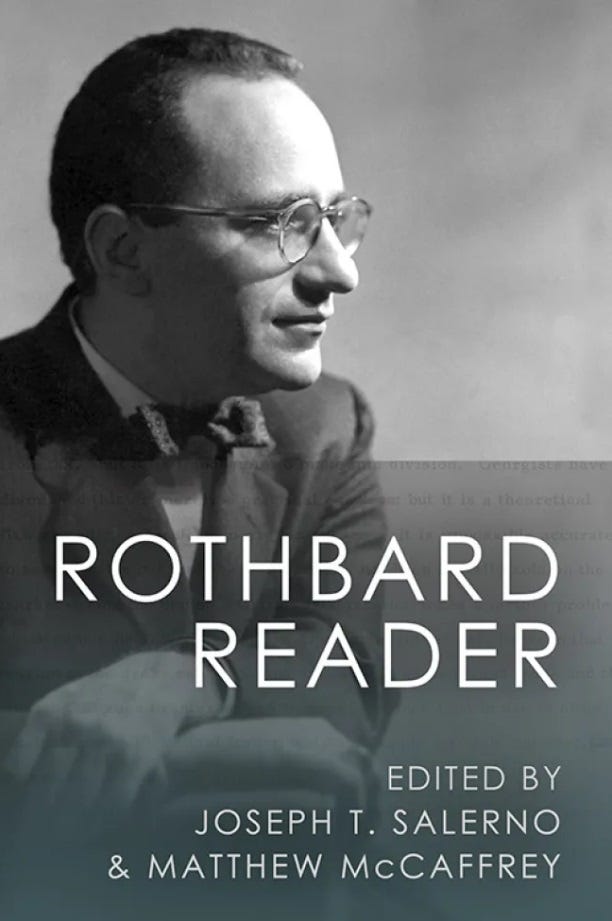
The Rothbard Reader
Clearly, Salerno harbors little interest in the ruling elite—a prerogative that is his to exercise. Yet, does he also downplay the ruling elite when explaining Rothbard’s theories in The Rothbard Reader, which Salerno co-edited with Matthew McCaffrey?
First, let us check the index of the The Rothbard Reader. Surprisingly, “ruling elite” is absent, and a search of the book yields no mentions of the term. This omission is both striking and disappointing. Remarkably, The Rothbard Reader omits the concept of the ruling elite entirely!
Next, search for “ruling class.” The index lists a single reference. It leads to the 1976 Penthouse interview. In it, Rothbard provides a brief and somewhat underdeveloped explanation of the ruling class that only mentions the Rockefellers. This interview, from 1976, seems to predate the full development of his ruling elite theory.
Penthouse: Who, then, constitutes the ruling class in America today?
Rothbard: Well, I would say it’s a coalition of several groups. Obviously, the ruling politicians and bureaucrats are part of it. And in it, too, are those particular big businessmen who are aligned as allies of the state. Now, clearly, the Rockefellers and corporations like General Dynamics, which get most of their income from the state, would be included. And, as junior partners, so to speak, the unions, like the AFL-CIO unions, are a part of this grouping, particularly the leadership of these unions. Those are the basic elements of our ruling class. (p. 27)
Surprisingly, despite the index noting only one mention of the ruling class, a deeper computer search of the The Rothbard Reader reveals 18 mentions of “ruling class”. These are primarily in Chapter 28, titled “Economic Determinism, Ideology, and the American Revolution.” Written in 1974, this article focuses on ruling class dynamics rather than the later, more refined ruling elite theory. Nevertheless, it offers significant insights, making it puzzling that the index fails to reference these mentions.
Ruling dynasties
So, is Salerno systematically trying to hide Rothbard’s theory of the ruling elite? Not quite since Salerno does include one interesting article of Rothbard’s which ends dramatically by exposing the ruling elite:
Chapter 30. Unhappiness with the National Banking System
… By the turn of the century the political economy of the United States was dominated by two generally clashing financial aggregations: the previously dominant Morgan group, which had begun in investment banking and expanded into commercial banking, railroads, and mergers of manufacturing firms; and the Rockefeller forces, which began in oil refining and then moved into commercial banking, finally forming an alliance with the Kuhn, Loeb Company in investment banking and the Harriman interests in railroads.2 Although these two financial blocs usually clashed with each other, they were as one on the need for a central bank. Even though the eventual major role in forming and dominating the Federal Reserve System was taken by the Morgans, the Rockefeller and Kuhn, Loeb forces were equally enthusiastic in pushing, and collaborating on, what they all considered to be an essential monetary reform.2
[Continues in footnote 2:] Indeed, much of the political history of the United States from the late nineteenth century until World War II may be interpreted by the closeness of each administration to one of these sometimes cooperating, more oft en conflicting, financial groupings: Cleveland (Morgan), McKinley (Rockefeller), Theodore Roosevelt (Morgan), Taft (Rockefeller), Wilson (Morgan), Harding (Rockefeller), Coolidge (Morgan), Hoover (Morgan), and Franklin Roosevelt (Harriman-Kuhn Loeb-Rockefeller). (p. 231, emphasis added)
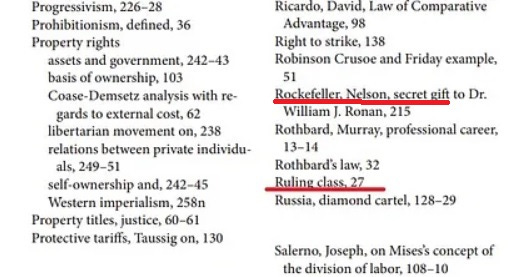
This is an exceptional quote that nearly redeems the day—or the book. Regrettably, no further details are provided about these power blocs, even in the footnotes. Most strikingly, this compelling citation is conspicuously absent from the index! It includes only a solitary reference to the Rockefellers, bearing no relation to the ruling elite. Even more enigmatic is the fact that Rothbard’s quotations feature at least six direct mentions of the Rockefeller family as part of the ruling elite, none of which appear in the index.
Conclusion
The Rothbard Reader offers no references to the ruling elite or its ruling dynasties. The footnotes omit Rothbard’s articles or books that address the ruling elite and remarkably there is no bibliography. Moreover, not a shred of information is provided about the Kuhn, Loeb group, which is also entirely excluded from the index! It does include the scientist Thomas Kuhn but not Kuhn, Loeb bankers. Jews are obviously taboo. In fact, the J-word does not appear at all in the book.
Perhaps all this is unsurprising, given that the indexes of both of Salerno’s books omit almost all references related to the ruling elite or the three ruling dynasties (Morgan, Rockefeller, Rothschild/Kuhn, Loeb). Whether by coincidence or design, it is evident that Salerno personally harbors little interest in the membership of the ruling elite. Nevertheless, he successfully fulfills the most critical task in The Rothbard Reader by enabling Rothbard to reveal the existence of the ruling elite and its division into three dynastic factions.
One point for the Gentiles!
PS:
All articles published in Ruling Elite Studies are collaborative efforts. Please contribute ideas, points, citations, images, and references in the chat. This way, all articles are continuously being improved.