

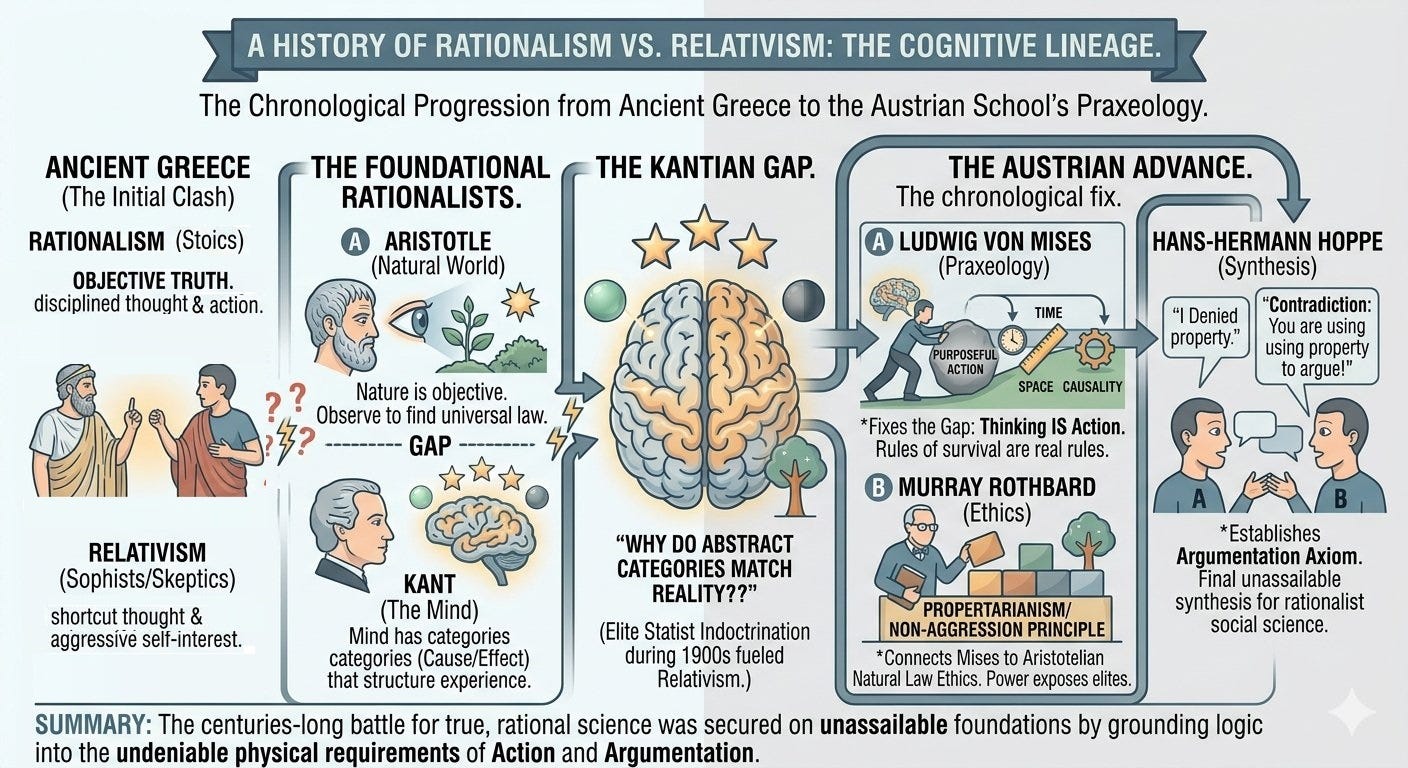
Image: Summary of the article. (This Substack distills every article into time-saving syllogistic infographics. Paid subscribers get more infographics plus videos, personal consultations and group discussions about rationalism, history and trifecta strategies.)
Introduction
Throughout history, human thought and scientific paradigms have been battlegrounds for two competing perspectives: rationalism and relativism. For millennia, both traditions have captured the minds of scholars. Even in classical antiquity, the rationalist Stoics waged an intellectual war against the relativist Sophists and Skeptics.
Two Genetic Perspectives
These divergent views appear to reflect distinct, genetically conditioned mindsets rooted in diametrically opposed psychological temperaments. Rationalism demands rigorous discipline in both intellectual reasoning and physical conduct. In contrast, relativism promises intellectual and behavioral shortcuts. Within society, relativism fosters a toxic mixture of intellectually lazy arrogance and aggressively violent self-interest. Consequently, our base animal instincts consistently pull human nature away from objective truth and toward relativistic decay.
Aggressive Animals: The Seven Primal Instincts Sabotaging Liberty

Image: Summary of the article. (This Substack distills every article into clear images and diagrams—saving readers time and preventing shaky premises and reasoning from being hidden behind a torrent of words.)
Two Scientific Paradigms
Rationalism and relativism establish fundamentally incompatible foundations for inquiry. As a result, they yield contradictory theories, particularly within the social sciences—such as ethics, economics, politics, and history. The twin titans of the rationalist tradition are Aristotle and Immanuel Kant, though each championed a different emphasis. Kant elevated the rationalist tradition by introducing a highly structured, rigorously logical philosophical system.
Image: Free audiobook of Immanuel Kant’s The Critique of Pure Reason
[Below for paying subscribers a simplistic infographic summarizing Kant’s Critique of Pure Reason plus a cutie’s 10 minute video explaining the basic idea of the book.]
The Kantian Gaps
Unfortunately, Kant’s monumental system suffered from two glaring deficiencies. First, it failed to seamlessly bridge the laws of human consciousness with the laws of objective reality. This led especially young people too deep into idealism and mysticism. Second, it failed to construct a comprehensive, universally binding system of ethics. This was devastating especially to the emerging classical liberalism.
While Kant was acutely aware of these shortcomings, and generations of Kantians attempted to resolve them, these foundational “Gaps” persisted. This unresolved philosophical vulnerability—coupled with ruling elite-sponsored, statist indoctrination—allowed relativism to seize intellectual dominance during the twentieth century.
Relativism vs. Rationalism: Cloaking Jewish Dominant Minority

Ruling Elite Studies is a reader-supported publication. To receive new posts and support my work, consider becoming a free or paid subscriber.
Praxeology
Fortunately, one thinker emerged determined to halt the relativist onslaught: Ludwig von Mises. In his 1949 masterpiece, Human Action, Mises presented a revolutionary rationalist paradigm that resolved the Kantian gap through the Axiom of Human Action. By basing praxeology—the logic of purposeful action—on that self-evident axiom, Mises demonstrated that a coherent, all-encompassing body of deductive science could be systematically derived. This monumental breakthrough eclipsed even the Copernican and Newtonian revolutions.
Predictably, ruling elite punished Mises for his genius, as unyielding rationalism is inherently anti-statist and a lethal threat especially to the Jewish faction of the ruling elite. Mises’ prestigious European career was sabotaged, and even after immigrating to America during World War II, he was systematically denied a rightful university professorship. Furthermore, Mises’s gentlemanly modesty prevented him from launching aggressive critiques against hostile peers. Lacking a specialized background in formal academic philosophy to make the epistemological mechanics of his thesis explicit, he was easily marginalized by mainstream academia.
Murray Rothbard
Fortunately, Mises’s brilliant disciple, Murray Rothbard, synthesized his mentor’s work into a comprehensive rationalist system. Rothbard achieved this by replacing Mises’s semi-relativist, utilitarian leanings with an objective, Aristotelian natural-law framework. In The Ethics of Liberty, Rothbard fortified the praxeological system by delivering a rigorously propertarian version of natural law.
From the unshakeable ethical foundation or propertarianism, he mapped out the economics of mutually beneficial exchange step-by-step in his two-volume Man, Economy, and State, and exposed the parasitic nature of state and its interventions in Power and Market. These theoretical works subsequently served as the bedrock for his five-volume revisionist historical epic, Conceived in Liberty. Unlike the modest Mises, Rothbard fearlessly unmasked ruling elite power structures - including the Jewish faction - in uncompromising exposes like Wall Street, Banks, and American Foreign Policy.
Hans-Hermann Hoppe
Despite his immense achievements, Rothbard also lacked the formal philosophical training required to completely dismantle academic relativism. His reliance on the Aristotelian concept of an entity’s “nature” still left the Kantian Gaps vulnerable, lacking the airtight, argumentative power needed to decisively win the debate. It was therefore a moment of profound personal triumph for Rothbard when, in the 1980s, he met and allied with Hans-Hermann Hoppe—a philosopher of impeccable Germanic academic credentials, great courage, and uncompromising libertarian principles.
Rothbard enthusiastically championed Hoppe’s profound contributions. Utilizing his mastery of formal philosophy, Hoppe articulated precisely how the action axiom successfully grounds Kant’s mental categories into physical reality through logic of action and protophysics. Furthermore, Hoppe formulated the Argumentation Axiom as a sister to Action Axiom, effortlessly bridging the chasm between pure philosophy and propertarian ethics. Through this final synthesis, the grand rationalist system was at last secured upon axiomatic foundations.
Conclusion
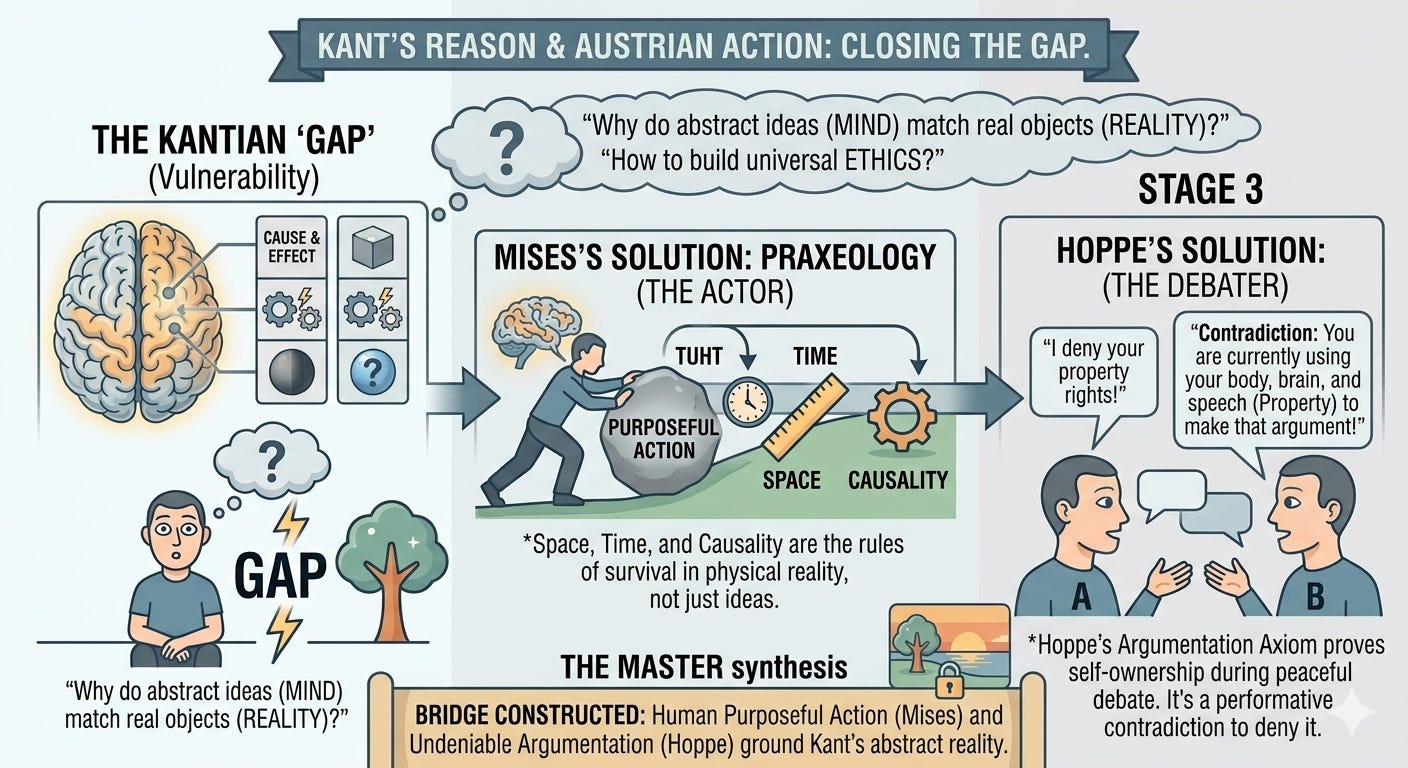
The historical struggle between rationalism and relativism culminated in a profound epistemological crisis when Immanuel Kant left a critical gap between human consciousness, physical reality, and universal ethics. For decades, this vulnerability allowed state-backed relativism to corrupt the social sciences, until Ludwig von Mises grounded the laws of thought into the physical world through the Axiom of Human Action. Murray Rothbard expanded this praxeological framework by anchoring economics and politics within an objective, property-based natural law.
Finally, Hans-Hermann Hoppe resolved the remaining philosophical vulnerabilities by introducing the Argumentation Axiom, proving that individual self-ownership is logically undeniable during peaceful debate. By synthesizing these breakthroughs, Hoppe successfully closed the Kantian Gaps, establishing an airtight, axiomatic foundation for true science.
Marco, may I ask a basic Emperor has no Clothes question.
Why do we always have to use copies of copies in our pardigms of understanding.
Such as: Kant, or Plato, or Aristotle?
Did someone teach them how to think?
Or did they just...THINK?
"ethical foundation or propertarianism"
One of the other.