
Social Network Analysis Exposes Ruling Elite
Historians Finally Studying Ruling Elites With One Omission

Introduction
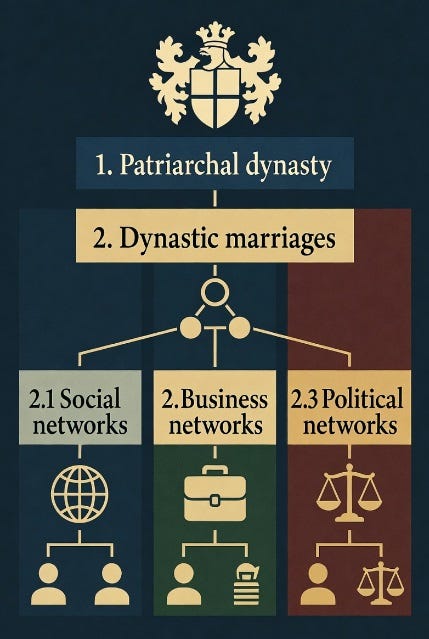
Social Network Analysis (SNA) is renowned for the “Six Degrees of Separation” concept, which underlies the “small world phenomenon” and demonstrates how rapidly information spreads—the basis of the famous game by that name. The Austro-Libertarian Theory of History emphasizes that in the same way, influence can travel quickly, enabling relatively efficient control through extended families and other social networks, much like centralized corporations or state bureaucracies. This control travels through four stages of interaction: dynastic (genetic), cultural (gift/barter), economic (money) and political (statist aggression).
Praxeological Theory of Child Development

Ruling Elite Studies is a reader-supported publication. To receive new posts and support my work, consider becoming a free or paid subscriber.
For reasons that remain unclear, historians long resisted applying even the simplest social network analysis to the study of social, economic and political power. Many historians especially refused to study Jewish dynasties despite the clear similarities of Gentile and Jewish dynasties especially before the twentieth-century.

Image: Medici and Jewish patriarchs. Image by Grok.
Court historians
Fortunately the situation started to change in the 1990’s when historians became interested in the ruling families of Italy.
“Overall, SNA as a branch of knowledge is comparatively recent and developed gradually over time. The discipline expanded and spread across various fields of research, ranging from psychology and sociology, to mathematics, and physics. For a long time, however, it remained largely unnoticed by historians.
Still, in the late 1990’s, Charles Wetherell highlighted the persisting unfamiliarity of historians with such a method, and wanted to contribute to its diffusion. He provided both a theoretical explanation of SNA and a practical demonstration of its application.... He highlighted the structure nature of networks, which enables scholars to identify and study patterns, crucial in defining the economic, political, and social structure.” (Elise M. Dermineur, Matteo Pompermaier (Eds.). Credit Networks in The Preindustrial World: A Social Network Analysis Approach. Palgrave MacMillan 2025. p. 5.)
Historical power studies
Big change came with the landmark 1993 study, “Robust Action and the Rise of the Medici, 1400–1434,” by sociologist John Padgett and political scientist Christopher Ansell. This work demonstrated how the Medici controlled Florence through business and matrimonial alliances, making Historical Network Research (HNR) respectable in historical studies.
“The work that probably contributed the most to the spread of SNA in the historical field was authored by the sociologist John Padgett and the political scientist Christopher Ansell. They managed to bring attention to the analysis of social networks and boost enthusiasm around the methodology. Their seminal paper “Robust Action and the Rise of the Medici, 1400-1434“ had a relevant influence on historical research and stands as one of the earliest-and one of the best-known-applications of social network analysis to historical sources.
The study delves into the intricate marriage, economic, and patronage network built by Cosimo de’ Medici, and the critical role it had in his rise to power in fifteenth-century Florence. The authors highlight the concept of “robust action” referring to Cosimo’s distinctive style of control. They show that the Medici network comprised two distinct components: individuals with whom the Medici established exclusively economic relations, and other individuals with whom the Medici established marriage alliances. Cosimo’s network was strongly affected by residential patterns and resulted in a highly centralized structure capable of assuring top-down control and enforcing discipline. (Elise M. Dermineur, Matteo Pompermaier (Eds.).” Credit Networks in The Preindustrial World: A Social Network Analysis Approach. Palgrave MacMillan 2025. p. 6.)
Methodological individualism
Amazingly, Pagett and Ansell are almost Austro-Libertarian in their emphasis on methodological individualism:
“Regardless of time or place, political centralization lies at the heart of state building. … We analyze the centralization of political parties and elite networks that underlay the birth of the Renaissance state in Florence. ... Methodologically, we argue that to understand state formation one must penetrate beneath the veneer of formal institutions, groups, and goals down to the relational substrata of peoples actual lives.” (John F. Padgett and Christopher K. Ansell. Robust Action and the Rise of the Medici, 1400-1434. (American Journal of Sociology, Volume 98, Issue 6. May, 1993. p. 1259.)
Padgett and Ansell often sound libertarian. They even note how the essence of state power is the deceptive creation of legitimacy:
“The contradiction, in state building or in any organization, is between judge and boss: founders cannot be both at once. Stable self-regulating maintenance of rules (i.e., legitimacy) hinges on contending actors’ conviction that judges and rules are not motivated by self-interest (Elster 1983; Padgett 1986; Douglas 1986).
At the same time, the nightmare of all founders is that their organizational creation will walk away from them. As Weber recognized long ago, in crisis (sooner or later inevitable), direct intervention in or overt domination of locked-in interactions is a sure sign of control’s absence, not of its presence.” …
Contemporaries deeply appreciated Cosimo’s power. ... Machiavelli ([1525] 1988), almost a full century later, still held Cosimo and his family in awe-attributing both all good and all evil in recent Florentine history to Cosimo’s deep and ruthless machinations. Yet the puzzle about Cosimo’s control is this: totally contrary to Machiavelli’s portrait in The Prince of effective leaders as decisive and goal oriented, eyewitness accounts describe Cosimo de’ Medici as an indecipherable sphinx (Brown 1961, p. 186).
“Cosimo was anxious to remain in the background, hiding his great influence, and acting, when need arose, through a deputy. As a result, very little is known of the measures for which he was directly responsible” (Gutkind 1938, p. 124) Despite almost complete domination of the state, Cosimo never assumed lasting public office.” (Ibid. p. 1260-3. Emphasis added.)
Dynastic power
Medicis were able to capture the state by a combination of business-banking power and arranged marriages. This was relatively easy because of the highly dynastic nature of Florentine families.
“Relations between distant lineages in an elite clan were less solidary during the Renaissance than they had been in medieval consorteria times. But, contra Burckhardt (1860) and Goldthwaite (1968), the Renaissance in Florence was not an era of individualism. Relations among households in a clan were typically, although not universally, very strong (see also Brucker 1977, pp. 18-19). The turbulence of the times reinforced defensive cohesion (Brucker 1977, pp. 19-21; Kent and Kent 1981).” (Ibid. p. 1267. Emphasis added.)
These dynasties were naturally led by family patriarchs.
“Note 50 Needless to say, modern conceptions of romance are anachronistic in this deeply sexist context. Patrician fathers arranged marriages between sons around 35 years old and daughters in their teens (Herlihy and Klapisch-Zuber 1985).” (Ibid. p. 1294. Emphasis added.)
Social friendship networks as well as patronage, corruption and personal loans were also important in maintaining power but these were secondary to matrimonial and business bonds.
“More particularly, it is clear that marriage and trading relationships are the primary driving forces behind this blockmodel portrait of the Florentine elite. ... On the weak tie side, personal friendships and personal loans operated in large part within the framework of marriage and economic relations.” (Ibid. p. 1313. Emphasis added.)
Padgett and Ansell showed how the Medicis were able to maintain their power for generations by dominating a network of about 100 families. They showed this with a detailed study of the leading families and created a brilliant network charts.
Conclusion
It can be done. Padgett and Ansell show how it is possible to study the nature and development of the dynastic Florentine ruling elite. Now it is time to do the same to the even more powerful patriarchal and dynastic Jewish elite.
Despite the obvious examples of social networks throughout history, the tribes of "democratic" Athens, the Patrician Families of Rome, and most obviously the Rhodamites or Rhodomites of the Khazar kingdom, this specialized analysis of history is evidently left out and silenced as much as possible.